Kera sit2sit compared with other hoists

A sling hoist can lift anyone but needs a sling fitted under the person and, in most care settings, two caregivers.
A sit-to-stand hoist needs only one caregiver but the person has to bear weight through their legs and hold on.
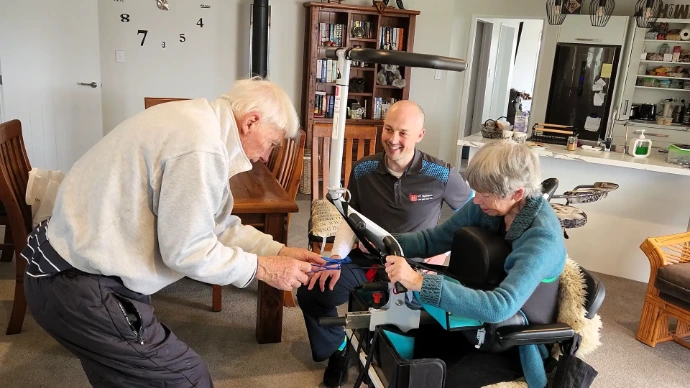
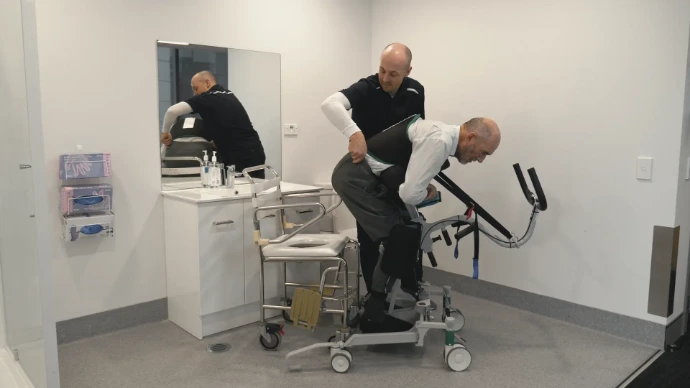
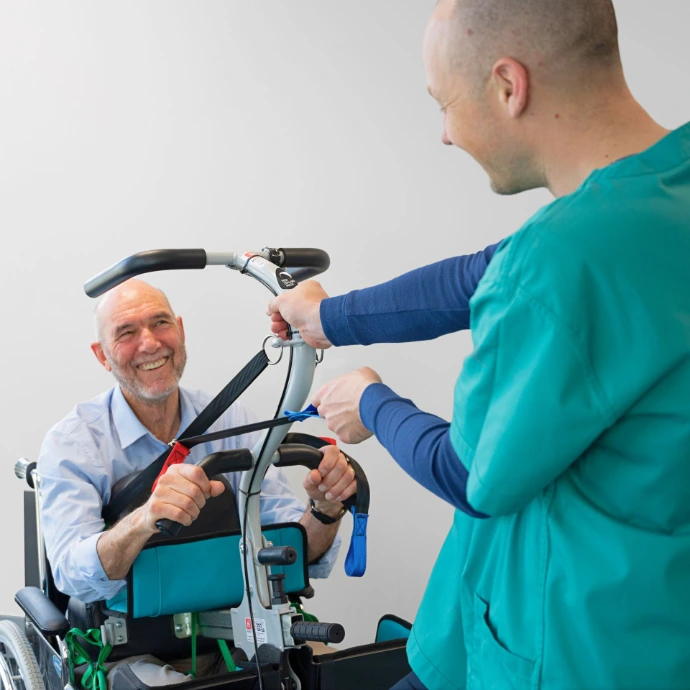
The Kera gives you the one-caregiver simplicity of a standing hoist for people who cannot stand, hold on or balance. It does this by firmly holding the upper body between the Chestpad and Backstrap and moving the person from one seat to another in a seated position.
That makes it the right choice for a large group of people, however the Kera doesn’t suit the needs of everyone. This page is meant to help you and your Therapist work out which.
The options at a glance
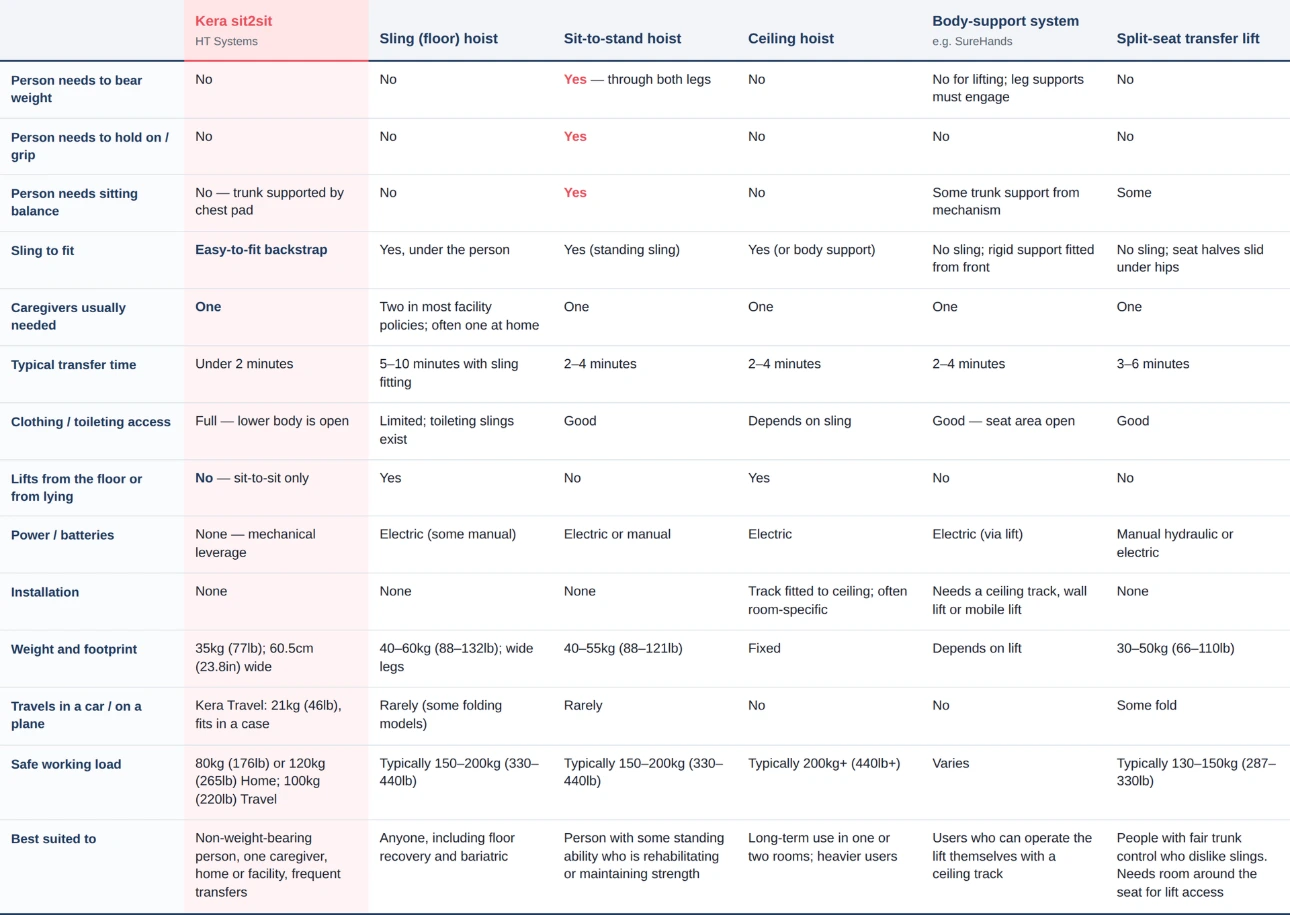
Figures for non-HT Systems' lifts are typical ranges, not specifications of any one product. Always confirm with the manufacturer.
The Kera is at its best when three things are true:
- the person can no longer stand or hold on,
- one caregiver is doing most transfers,
- and transfers happen several times a day.
That describes most people living at home with MND/ALS, advanced MS, MD, a high spinal cord injury, traumatic brain injury, a dense stroke, or double lower-limb amputation
For care facilities, the Kera is also what turns a two-person sling transfer into a one-person transfer without a policy change, because there is no sling and no suspended load — the person is supported from the front and moved in a seated position.
The Kera Home has a maximum safe working load of 120kg / 265lbs (Kera 120) and 100kg / 220lbs on the Kera Travel, so it isn’t a bariatric solution.
Seat heights need to fall approximately within 40–65cm (15.7"-25.6").
The most common question from Therapists is whether to recommend a ceiling hoist or a Kera hoist.
They solve different problems. A ceiling hoist lifts anyone from anywhere it can reach including the floor, and is the right answer for heavier users and for people who will need lifting in the same room for many years. It needs installation, usually a track per room, and a sling.
Rigid body-support systems (SureHands is the best known) also do away with the sling and leave the seat area open, and for people who can operate a ceiling lift independently they're excellent. The differences are that they attach to a ceiling track, wall lift or mobile lifter rather than being a self-contained device, they lift the person clear of the seat rather than moving them in a seated position.
The Kera hoist goes wherever the person goes — every room, the car, a holiday — with no installation, no power and an easy to fit Backstrap, for people who can be transferred sitting.
Plenty of homes have both: a ceiling hoist in the bedroom for bed and floor, and a Kera hoist for everything else.
The cost of that versatility is the sling. Before every transfer the caregiver has to work a fabric sling under the person — rolling them side to side in bed, or leaning them forward and feeding it behind them in a chair — then attach the loops to a spreader bar, lift, and reverse the whole process at the other end.
It takes five to ten minutes, it's the part of care most likely to injure a caregiver's back, and it's why most facilities require two staff for a sling transfer. The person is suspended in fabric, which many find undignified and which closes off the lower body, so toileting usually means a separate toileting sling or a second transfer.
A sit-to-stand hoist needs the user to bear weight through both legs, hold on to the handle and keep their own balance while a standing sling pulls them upright; if they can't, the sling rides up and the transfer becomes unsafe.
Split-seat transfer lifts take a third approach: a chair-like frame with a seat that opens in two halves, which the caregiver slides under the person's hips before lifting them from behind or below.
Like the Kera, they avoid using a full sling and leave the lower body reasonably accessible, and they suit people with fair trunk control who dislike being hoisted.
Where they differ is that the person needs enough sitting balance to stay upright while the seat is positioned, the lift needs clear room around the chair or bed to get in, and the transfer takes longer because of the positioning.
However, the Kera can't lift from the floor or from lying, and its safe working load is 120kg /265lbs, so a sling hoist remains the right tool for floor recovery and for heavier users. Many homes keep both.
Non weight bearing: The Kera's Chestpad and Backstrap support the upper body and the person is lifted into a comfortable position resting on their chest, which is why families often move from a sit-to-stand hoist to a Kera when standing is no longer safe.
Portability: The Kera goes wherever the person goes — every room, the car, a holiday — with no installation, no power and an easy to fit Backstrap, for people who can be transferred sitting. Plenty of homes have a ceiling hoist in the bedroom for bed and floor, and a Kera for everything else.

A note on cost
Buyers sometimes assume the Kera is expensive because it’s specialised. In Australia and New Zealand it is priced in the same band as a good electric sling hoist and well below a ceiling hoist once installation is included, and it’s fundable through the usual channels — see Funding.
Next step
Ask your Therapist to arrange a trial — our dealers will bring a Kera to your home or facility — or contact us and we’ll connect you with the nearest one.
