
What if travel didn’t require a plane ticket?
What if you could sit on the edge of the Grand Canyon…
Roll through the Colosseum in Rome…
Or even skydive out of a plane…
without ever leaving your living room?
For most people, virtual reality is still seen as gaming or entertainment.
But for people living with disabilities – especially those of us with spinal injuries – it could become something much bigger.
It could become a doorway to experiences that physical limitations have placed out of reach.
And when you combine virtual reality with assistive technology like the Kera hoist, something unexpected happens.
You don’t just watch the experience.
For a moment…you might actually feel like you’re flying.
A world that comes to you
Travel is one of life’s great joys.
Sitting in places you’ve only seen in photographs. Moving through historic cities. Seeing landscapes that make you stop and stare.
But the reality is that for many disabled people, travel can be extremely complicated.
Even when the desire is there, the logistics can be overwhelming – flights, accessible accommodation, equipment, caregivers, transport, fatigue, and cost. For some people those barriers mean certain places will simply never be possible to visit.
That’s where virtual reality begins to change the conversation.
VR won’t replace real travel.
But it can bring pieces of the world to you.
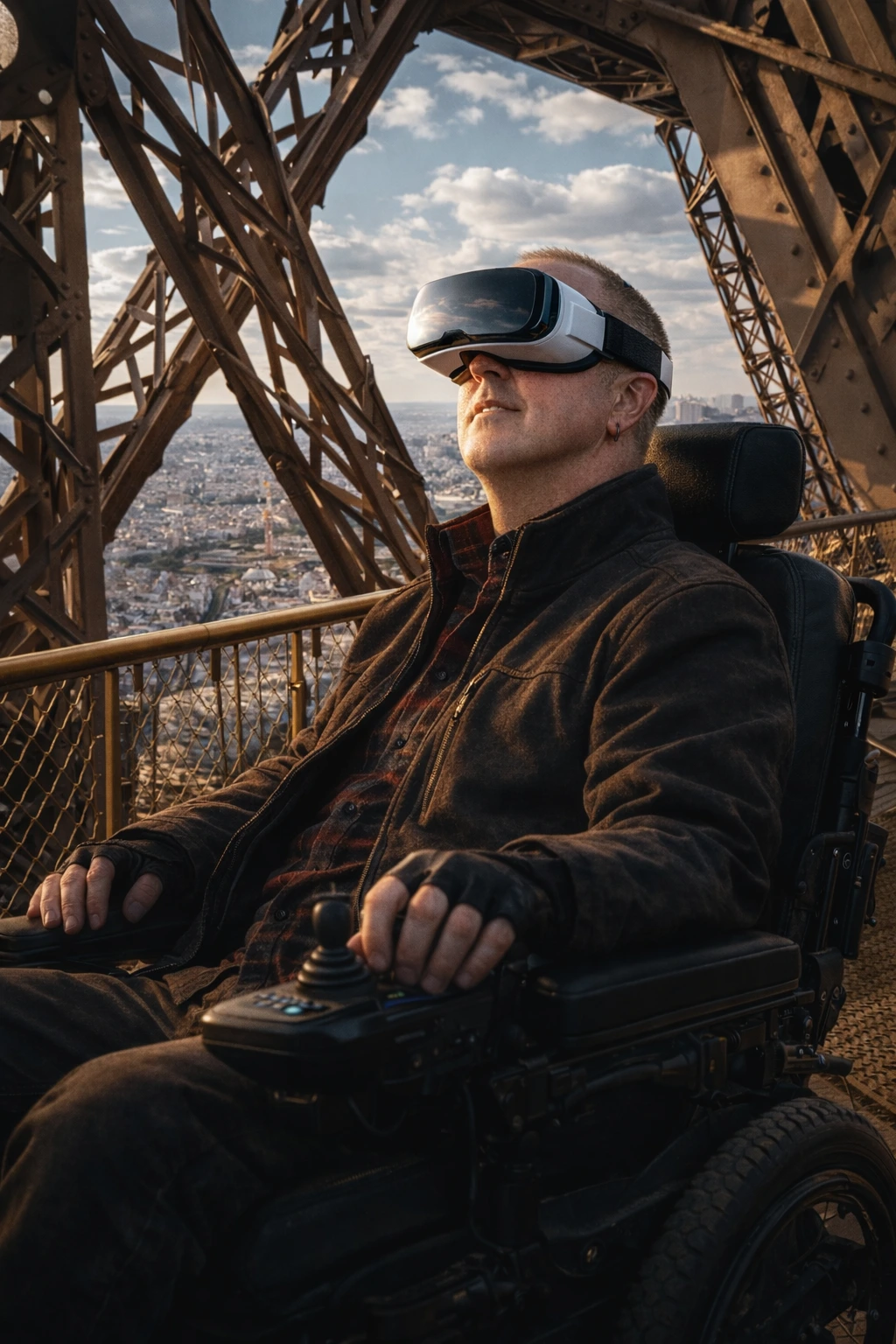
Put on a headset and suddenly you’re sitting on a cliff edge, exploring a city street, or sitting in the front row of a concert. The graphics aren’t perfect yet, but the sense of immersion is already powerful.
For someone whose physical world has become smaller than they would like, even that small escape can be incredibly meaningful.
More than entertainment
For people living with spinal injuries or other mobility disabilities, VR can be something beyond gaming.
It can be relief.
It can be stimulation.
It can be a reminder that the world is still big.
When you live with tetraplegia, as I do, life becomes structured around equipment, support, planning, and routine. You adapt. You build independence where you can. But there is always the reality that your physical world has limits.
Virtual reality changes that perspective.
Instead of staring at the same ceiling or the same television from the same angle every day, suddenly you’re somewhere else. Your senses are engaged in a different way. Your mind travels even if your body stays where it is.
And sometimes that shift in perspective can be incredibly powerful.
Where assistive technology fits in
This is where assistive technology and virtual reality begin to intersect.
A Kera hoist is usually seen as purely practical equipment. It’s about safe transfers, caregiver safety, and maintaining dignity in daily life.
Moving from bed to chair.
Chair to toilet.
Chair to another seat.
But good assistive technology often does something more.
It opens up possibilities.
With the right equipment, someone can be transferred comfortably into different seating positions around the home – perhaps into a recliner or lounge chair where they can sit back and relax properly.
That positioning makes experiences like virtual reality far more enjoyable.
Instead of being stuck in the same position all day, someone can settle into a comfortable position and immerse themselves in something new.
The hoist may only move someone a few metres across a room.
But the experience it enables might take them around the world.
The moment you realise you’re flying
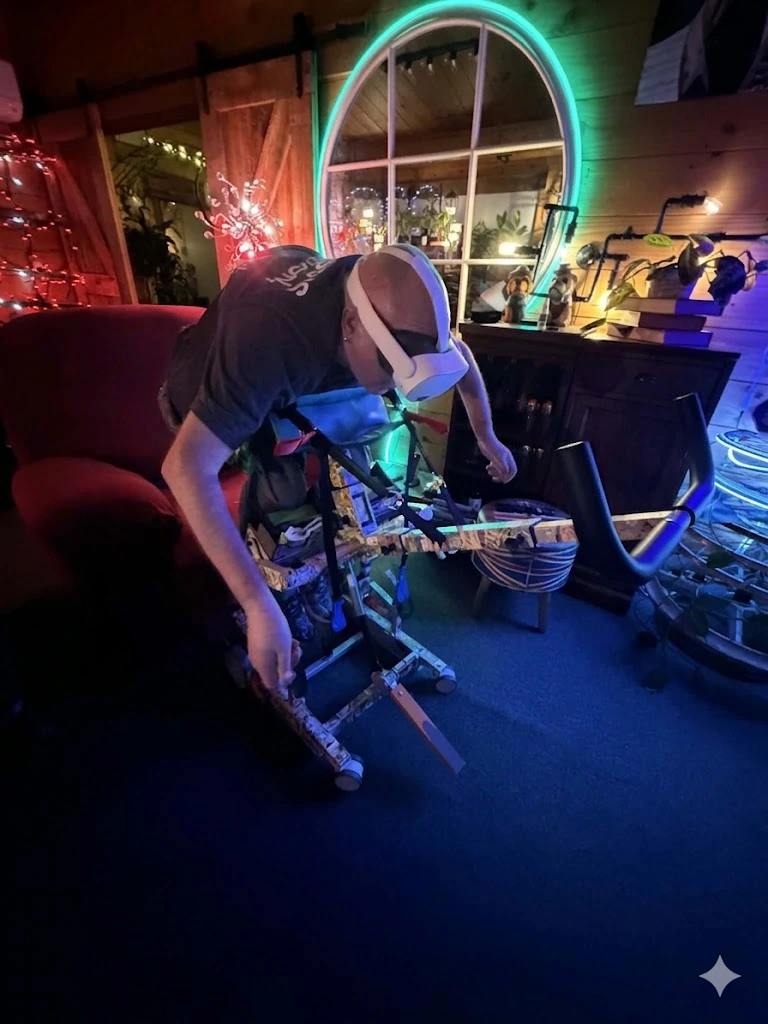
There’s also something about the Kera hoist that people don’t always notice in photos.
In pictures it looks like someone is simply standing in the sling.
But that’s not quite what’s happening.
When the Kera lifts you out of your chair, your feet are actually off the ground. You’re not standing. Your legs aren’t supporting you. The main support comes across the chest pad through the harness.
Your hands aren’t holding onto anything.
Your feet aren’t touching the floor.
In fact, I’ve actually thrown the footrests away – I don’t need them.
For a brief moment, you’re suspended.
In a strange but wonderful way, you’re actually flying.
Now imagine wearing a virtual reality headset while you’re in that position.
Imagine the VR world showing you skydiving.
For people who still have some sensation in their bodies, that combination could be the closest many will ever come to experiencing something like that.
Your brain sees movement.
Your body feels suspended.
And the illusion becomes surprisingly real.
I sometimes joke that once caregivers or family members realise this, you might have trouble getting them out of the hoist.
“Just one more go!”
It’s probably something the inventors of the Kera hoist never imagined when they designed it. They were focused on safety, dignity, and independence.
But sometimes great technology creates possibilities nobody expected.
A fascinating sensory effect
For people with tetraplegia there’s another interesting factor.
Many of us lose sensation in parts of our body – often from the chest down.
When you’re sitting comfortably and immersed in a VR environment, your brain receives powerful visual signals that suggest movement. But your body isn’t sending conflicting signals.
Your body is fully supported in a La-Z-Boy.
For some people that can make VR feel incredibly immersive.
It can trick the brain in a fascinating way.
What might make an able-bodied person feel grounded could instead feel like a convincing experience for someone whose sensory input works differently.
It’s one of those unexpected intersections between disability and technology that could create new kinds of experiences.
The future is only just starting
Of course, VR still has its challenges.
It’s not always a simple “click and play” experience yet. Sometimes the setup requires a phone or computer. Casting content can take a few steps. If someone has limited hand function, they may need a caregiver or family member to help start the experience.
It requires patience – but those of us who rely on support often already have that built into our lives.
Once it’s running, the potential is already clear.
Even something simple like watching YouTube in VR can feel like sitting in front of a giant cinema screen.
And the technology is moving fast.
AI-powered glasses and cameras are beginning to map environments in three dimensions. Experiences can be recorded in ways that allow other people to look around them almost as if they were standing there.
I immediately think about my Christmas light displays.
Every year thousands of people come to see them, but many people can’t travel to Napier. Imagine if someone could put on a headset and virtually wheel through the lights, looking around as if they were there.
That’s where this technology starts to become truly exciting.
A small piece of technology that makes a big difference
One thing I’ve learned over many years living with a spinal injury is that big experiences often depend on small pieces of equipment working well.
Something as simple as being comfortably positioned in the right chair can make the difference between enjoying an experience and just enduring it.
That’s where equipment like the Kera Home Hoist and Kera Travel Hoist quietly play an important role.
They allow safe, supported transfers into different seating positions around the house – a recliner, a lounge chair, or wherever someone is most comfortable.
For people with limited mobility, that flexibility can make experiences like virtual reality far more enjoyable.
And as virtual reality continues to improve, I suspect we’re only just beginning to see how assistive technology and immersive technology will work together.
The future of independence may not always involve travelling further.
Sometimes it simply means bringing more of the world to you.
Don’t be afraid of new technology
Technology has always helped people with disabilities live more independently.
Wheelchairs.
Voice control.
Smart homes.
Assistive devices.
The Kera Sit2Sit hoist.
Virtual reality may be the next step.
You don’t need to understand every setting or master it straight away.
Just be curious.
Because sometimes the next great journey doesn’t begin at an airport.
Sometimes it begins in your living room – with a hoist, a headset, and the courage to explore.
The future belongs to the curious
Thirty-five years ago I watched a science-fiction film called The Lawnmower Man. It imagined a world where people could experience entirely new realities through technology.
At the time it seemed far-fetched.
Today we’re watching that future slowly arrive.
For people with disabilities, these tools – including innovations like the Kera Sit2Sit hoist – have the potential to open entirely new worlds.
The future will belong to those who are curious enough to explore it.
Yes Meta I am open for sponsorship 😊
Mark Williams is a Kera Travel user, Investor and National Sales Manager at HT Systems.
Want to see if a Kera sit2sit hoist is the right solution for you:
They’ve genuinely changed my life—and, just as importantly, helped me prepare safely and confidently for what’s coming next.
